
I'll Stay the Same
Some reflections on concert-going

You’ll lose it, Hemingway is said to have said, if you talk about it. Maybe we can follow that with a corollary: if you don’t write it down fast, you’ll have a hard time ever getting it back.
The experience of concert-going hews to these edicts almost by definition: as an audience member, you subject yourself to the procession of songs, and the evanescent thoughts and feelings that may follow within your head of heads, your heart of hearts; the most active thing to do is applaud and issue a whoop or whistle. Sway your hips. Maybe turn to the one you are with, share an embrace, handclasp, wink, or nod. You are there to bear ecstatic witness.
This summer, within a sequence of a few weeks’ time, I went to see Dinosaur Jr. at the Prospect Park Bandshell, the Yeah Yeah Yeahs at the Upper West Side’s Beacon Theater, and finally Willie Nelson’s Outlaw Music Festival, featuring Bob Dylan, Wilco, and Lucinda Williams, at the Saratoga Performing Arts Center (SPAC).
It was a strong show, but I have the least to report about the first: at the last minute, an old buddy returning to Brooklyn for a visit from Atlanta reached out to say that he, the wife, and daughter were going to see Dinosaur Jr. play in the park, and living within reasonable walking distance, I didn’t see any call to decline to join them. Yeah, I knew I’d be essentially a tourist there, having never been a real Dino Jr. head; I didn’t know the band-members’ names, and the band’s name itself evoked, if anything for me, the MTV music video for the best-known of their songs, featuring the guys hitting golf balls from platforms in the sky. I never disliked them either—they seemed cool, cool enough—but the act’d never quite lodged in my heart; they were there in the era when I was a teenager, and everything, all art passing as commerce or commerce pretending to art, felt important beyond measure, but somehow their music, so much as I ever listened to it, didn’t register as dire enough: I wanted Pearl Jam, Soundgarden, Blind Melon, Alice in Chains, Stone Temple Pilots; the happy-go-lucky exceptions in my contemporary listening catalogue, like the Lemonheads, had evinced a persona in which I saw myself (the song about falling into a crush; the one about laughing with a half-alienated friend as a car rolls by outside; the other about living always toward some imagined embrace).
But I digress. My buddy and I are getting older, and so apparently are Dinosaur Jr. Their lead singer, J Mascis (I looked this up after), gray-bearded, reedy bodied, and with long straight gray hair too, looks sort of wonderfully ancient these days, like the actor Harry Dean Stanton did possibly from the time he turned thirty-three years old. Or that’s how it appeared from where I was standing off to the right side, facing the stage. The bassist, on the other hand, Lou Barlow, projected an energy that made me think they must have replaced the original with a younger performer (as, for a stretch of years in Dinosaur Jr.’s history, they did replace Barlow, it turns out), but no, that was him, with the dark poofy head of hair and the antic postures. This group, they were just doing their thing, and their thing is cool expressly because it was always just a little outside of what was widely celebrated at the time, and also, because, lo, these many years later, they’re still doing it. The warbly distorted fuzzed-up shredding, the torque, the scratchy lyrics on top: somehow I pictured multi-colored triangles intersecting in geometric waves, over top of which floated the singers’ deadpan voices. Apparently, that night was Barlow’s birthday, too, and so there was a moment of personal acknowledgment between the band members, before they ended the show with a cover of “Just Like Heaven” that I thought was rad, then a screamy guest vocalist took the mic to play them out with a cover emblematic of their punk rock roots.
My buddy and I went afterwards to Park Slope Ale House for a nightcap. I had the tickets for the Yeah Yeah Yeahs show coming up, I knew, a pair I’d bought several months prior, with the date now imminent. Not for the first time I’ve figured, well, maybe by then I’ll be coupled up again. Then the calendar pages turn, the dates roll by, and I’m looking around any room that I’m in, like, Well, maybe she would want to go? Or maybe her? Could just ask? Why not. A lark. Carrying around this sort of soft spot: calling it “a wound” feels grandiose, but space to be occupied. There’s what’s living inside of us that has yet to express wanting only for the right mirror, or maybe by middle-age what’s true is that there used to be such potential, but now what’s in there has probably been cycled through several times in one fashion or another, and what’s needed is an anchor, someone who brings the jumble of the past into defined focus.
So I was looking around the room inside the Ale House, which wasn’t all that heavily peopled, catching sight of some very young women—could I really ask her? No, no, right, couldn’t possibly—while talking with my buddy, because we’re kind of old, about people we knew pretty well from our age cohort who’ve died. That first happened to him relatively young, on the precipice of high school graduation in Atlanta: a good friend, someone he and many others had high hopes for, slated to attend West Point the following autumn, taken in a freak accident on a class excursion to a waterfall. Kind of thing where he hit his head, lost consciousness, and went under in the pool at the bottom. Nobody noticed enough to pull him to the surface in time. My buddy was not there, hadn’t made that trip, but recalled the chill of hearing about it, and the other time, months earlier, when a group of them, underage, were attempting to purchase beer at a gas station, with my buddy, the most adult-seeming of the bunch, elected as point man, the one to go to the counter and present the fake ID. Police cruiser pulled into the lot right as he was exiting the sliding front doors, several freshly purchased cases under his arms, and the friends who’d been waiting on him, watching and cheering him on, all ran for it, around the back of the station and off into the night. All, except for this kid, or young man, who happened to be Black and bound for West Point. And my buddy recalls that moment crystalline to this day, of his saying to the friend, who always and forever will be that young man in his mind, Hey, you should go too, as the officers started to exit their vehicle. And his friend refused. Said he would remain. That’s character! my buddy says however many years later, however many years gone.
It’s easy to remain when the coast is clear; what’s defining is the choice to stand by when it isn’t. The officers were also impressed, letting both off with a warning. That one gesture, that one choice, by his departed friend has carried all the way forward to this day. If he had lived, who knows, maybe my buddy’s friend would have fallen on a mountainside in Afghanistan—or maybe he’d be the US Senator from Georgia. Counterfactuals can go on forever, and eat up every sort of present possibility. The potential, though, lingers on in the hearts of those who remember.
Despite the power vested in me by that extra ticket, I didn’t ask any strangers, young, old, or in-between, whom I might have believed to be Karen O fans. In the end, I bowed to convenience and asked another buddy who lives close to the Beacon if he wanted to go. We met beforehand at the Museum of Natural History, being that it was a hot day (in a hot summer) and his girlfriend had picked up a membership there on the spur of the moment when she found herself waiting on a line she wanted to blow past. Big Teddy R. and the patronizing statue of him on a horse looming over two Native Americans no longer commands the park-facing front entrance, which does feel, in the statue’s absence—or rather in the absence of any statue at all—a little naked. Indoors, there’s another of Teddy sitting on a bench, with visitors eager to take a load off welcome to join his big-bellied, metallic rendering, the silently approachable version having outlasted the high and mighty that used to be situated outside.
Speaking of the high and mighty, it occurred to me on the accelerated walkthrough of the dinosaur wing that my buddy and I chose to pass the half hour before concert time: Turtles are, secretly or not, our quiet gods. They’ve been around, it seems, in one form or another, since time immemorial. Of the dinosaur skeletons themselves, I was struck that raptors apparently had bone sockets around their eyes, whose placement within a museum case lent their skulls the illusion of menacing sight, as if the bodily architecture that the living creature once carried inside of itself were capable of looking out at me with hunger across the many millennia since its host breathed its last. We, as a species, reconstruct this deep past in order to haunt ourselves, after a fashion—but there’s a thrill in it too, the human capacity to reclaim what was lost, and hold that consecrated being up to our present, and see, by contrast, where we stand in relation to what once was. My buddy and I agreed that the triceratops is both of our favorites; we took a smiling selfie in front of one armored skull and sent the picture to his girlfriend, a sort of redemption of her impulse to pay for membership practically yesterday (in terms of millennia).
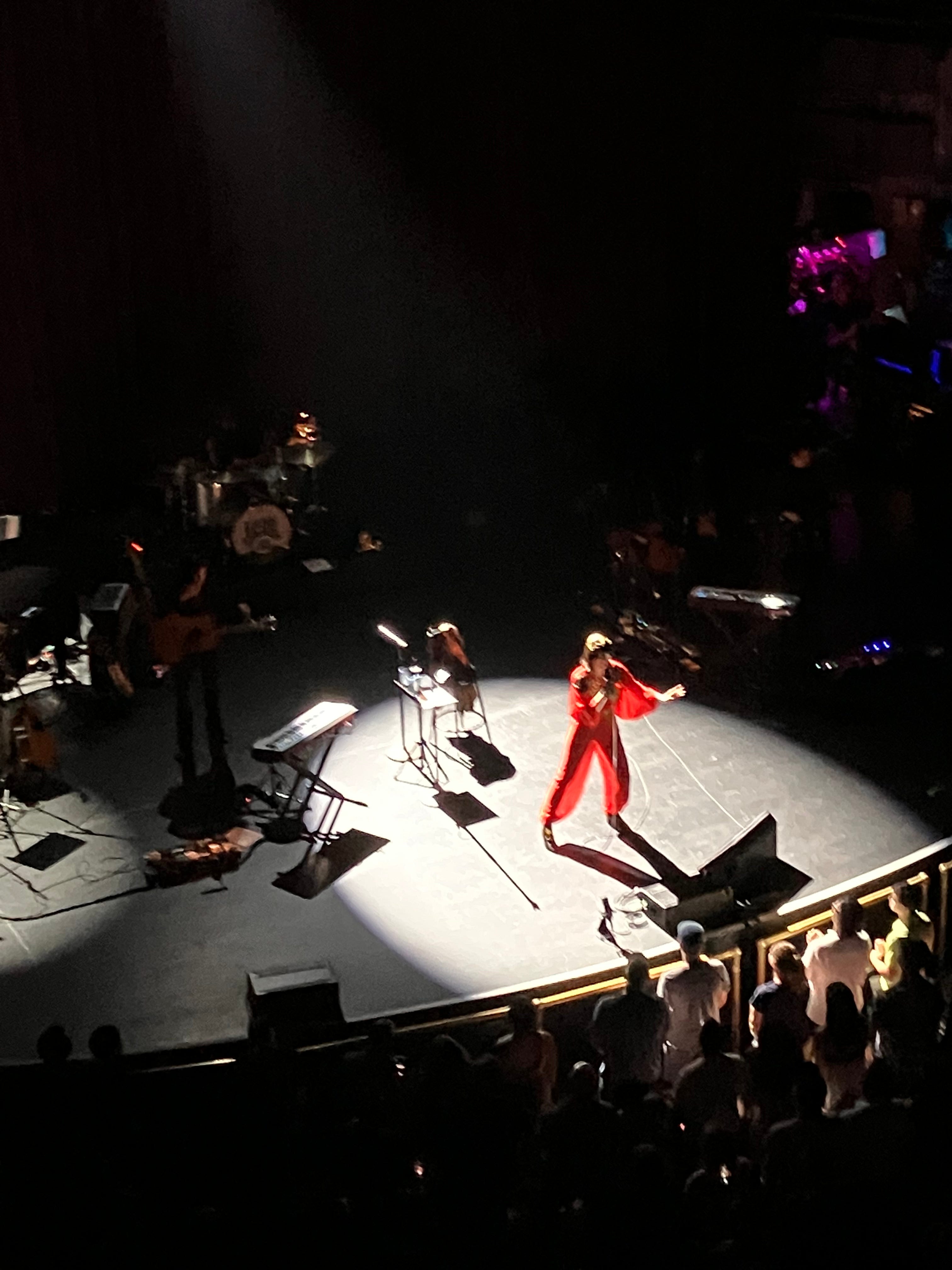
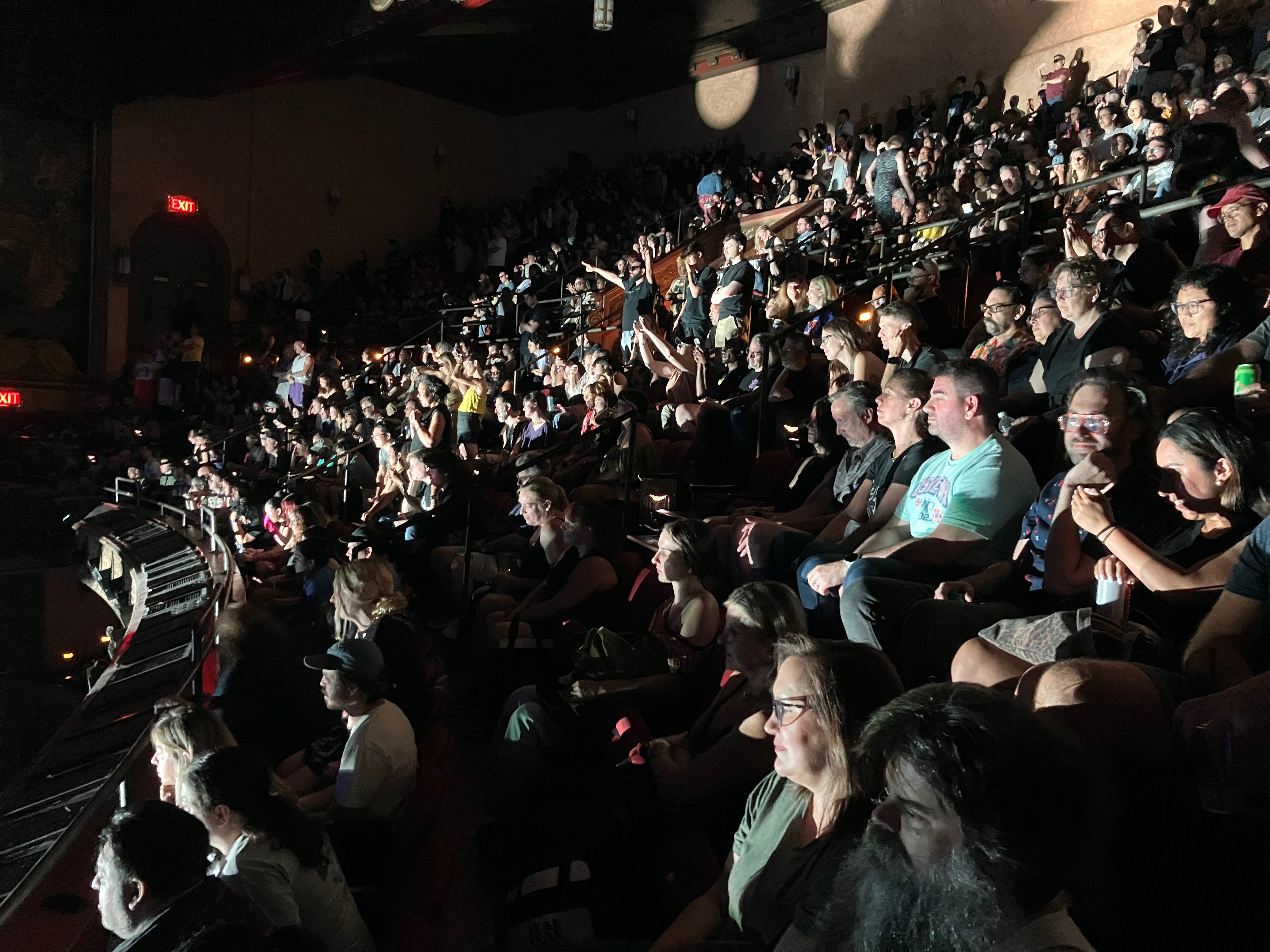
With questions of greatness on the mind, in terms of what feels consequential and lasting, and the bones of that which dwarves our human aspirations to the same, I moved through the crowd bottlenecked at the entrance to the Beacon. Seated on the balcony level, we arrived to an opening act who was sitting center-stage, alone in the spotlight, and playing a moody, trance-like guitar that took me to a meditative place: no frills, just the ensorcelling beauty of the music of the spheres, as Leonard Cohen might have put it. I imagined a story where Karen O found this guy and decided to feature him before they went on. Another, where he was a friend, or acolyte, of Nicholas Zinner. The truth is surely out there to be discovered, but in the shallow pool of the present I beamed my projections at the stage. The performer periodically, for effect, struck dissonant notes that echoed up to us and to the ornamented ceiling. (Is there a name for that?, my buddy asked, gesturing toward the inverted spire that hangs there in place of a chandelier.) Calming, I imagined, is how the Yeah Yeah Yeahs, frenzied Lower East Side party animals of times gone by, might have experienced this sound in choosing to center it before taking the stage themselves.
The “Hidden in Pieces” tour was billed as a more intimate series of encounters: stripped down somewhat, inclined more toward the acoustic, but with a fuller array of musicians playing than the Yeah Yeah Yeahs’ original trio. Like Beck at Carnegie Hall with a complete symphony orchestra for another concert I feel fortunate to have caught in recent times, the band carried with them a string section, albeit much more circumscribed in number and effect. Putting her nervy spin on the classic gabby lounge-singer mold, Karen O talked the Beacon’s audience through the night’s transitions, with the suggestion to those down in front, whom must have paid the most for their tickets, to stand up, if the music so moved them, and dance. Select folks in the balcony were standing for the band practically from their opening number.
The first time I ever beheld the Yeah Yeah Yeahs was unintended, at least in regard to their specific act: a hot crowded summer day on Coney Island in 2002 for the Siren Music Festival. I believe I went alone, but ended up connecting with a small contingent of my recently graduated college cohort, a beautiful, kinda edgy lit-minded set alongside whose writings my own had appeared in various fishbowl publications over our four years in Vermont. Transported now to the heat and elbow-bumping grind of Brooklyn in July, we could see each other sweat and how we each wore our enthusiams. Or, well, some of us emoted, and others, myself included, probably kept our feelings for what we were seeing pretty close to the vest: You’ll lose it, if you talk about it. Repressive methodology, to be sure, which carries its own day-to-day harms and instabilities—but undoubtedly some measure of repression is necessary, somewhere along the way, if what you ultimately want to bring into being is a representation of life as it is lived in words, on a page.
A girl I was enamored of—her tall, bespectacled boyfriend of that time was also present—appeared completely electrified by Karen O. Even just the way she spoke her name, like the energy the lead singer had unleashed over the short time since the band’s inception, channeled through this girl, or commanding young woman rather, a high-minded and nervy and funny fan of the singer’s. For my part, I’d never heard that name before, but had turned out that day notionally for Modest Mouse and to see what all else was coming up. When the Yeah Yeah Yeahs took the small main stage, the crowd surged forward. The sound wasn’t great, through no fault of the band’s, but Karen O, whose hair I seem to recall was then falling in an art-world bowl-cut over her eyes which she thereby withheld from her onlookers’ line of sight, performed with frenzied gusto in some glitzy, maybe faux-golden, dress. But I might be making that part up; it has been a long time, in terms of an average human lifespan.
The band on stage, they were like the protagonists in a story we were collectively starting to tell ourselves about our incipient adulthoods and the people we would, however willingly, become. For many reasons, our fellowship, the small college crowd gathered that day, wouldn’t last. But the Yeah Yeah Yeahs have. (At the end of that day, I sat on the shore of Coney Island Beach alongside the then-boyfriend of the girl I was enamored of and watching the big freighters on the ocean in the distance; I was envisioning, as was my inclination at the time, catastrophe, a tidal wave, a big tent movie spectacular sprint from the shoreline, whereas he was projecting, as he often did, calm—a slightly irritable, mildly superior, calm; he said, I still recall, “Do you think they’re coming or going?” meaning the ships out on the water, but I felt somehow implicated in his question, caught with a kind of vertigo in between, and couldn’t find at that time the words to answer, at least not that I recall.)
“Sometimes I think that I’m bigger than the sound,” Karen O sang at the Beacon in late July of 2025, escalating in tone and urgency toward crescendo, acknowledging, it seemed, the band’s playfully serious aspirations. While, of course, contrasting that heady mania with an implicit recognition in the rising chorus of the song of what ultimately swallows those aspirations up, some steadily building time-powered tidal wave, from which, many, we might imagine, coming or going, take refuge in religious observance of one vintage or another. We all—or so many of us there together in the collective darkness—bobbed our heads to the rhythm of the sound.
For the encore she took the stage again in (funny) rainbow-alternating-in-flashes platform boots of the sort you might expect to see worn by a trans diva alive to the swirling varieties of life. The audience, standing on the balcony and down below, sang her lyrics back at Karen O. She went silent and held the mic out for the crowd to hear itself: such warm, flattering absurdity, these wild lives desirous to be known, arraying themselves after her fashion.
“Buckets of rain/ Buckets of tears/ Got all them buckets comin’ outta my ears/ Buckets of moonbeams in my hand”: despite a full decade of attending concerts whenever he blows through New York, I’ve never seen Bob Dylan and his band perform this song in my presence. And that didn’t change at SPAC (they’ve only played it once, in 1990, in all Dylan’s many years of touring), but I did get to hear for the first time in person renditions of old favorites “All Along the Watchtower” and “To Ramona”: “It’s all just a scheme, babe, a vacuum, a dream, babe, that tricks you into feeling like this.”
Following on Waylon Payne’s strikingly vulnerable opening act, recounting between songs his country star mother’s final days, the performer father whom he grew up not knowing too well, and some years given over to addiction—he told any audience member presently struggling with such challenges to write him a letter and he would respond—out rolled Lucinda Williams and her band, including two guitarists whose soloing skills were showcased in covers of George Harrison’s “While My Guitar Gently Weeps” and Neil Young’s “Rockin’ in the Free World.” Wilco played close to a full concert-length set, with two songs from the album Mermaid Avenue, one I love, wherein the band along with British balladeer Billy Bragg have put to music and voice old Woody Guthrie lyrics surfaced by the surviving Guthrie children from a lost trunkful. I haven’t been much of a Wilco guy since the late Jay Bennett was fired from the band; nary an idea of what kind of strife the migraine-prone Jeff Tweedy had to deal with in that regard, and can only imagine it must have been plenty bad—and yet, definitely in my early 20s and into my 30s I romanticized perhaps all out of proportion the notion of creative tensions as the source of great art, which I considered Wilco’s Being There and Yankee Hotel Foxtrot to exemplify. Nels Cline, who replaced Bennett, is about as versatile and deft a guitarist as there could ever be, but there’s maybe something, too, a little more cold, more alien about his sensibility versus whatever it was that the Tweedy-Bennett dynamic brought out. All that backstory, we might imagine, will wash away in time, with the songs alone what surfaces. Look no further than the Outlaw Festival’s originator and closing act, the 92-year-old Willie Nelson, resolute, in command, loving of country (an American flag, as always, flanking his portion of the festival that night), even a touch defiant toward the current horror-show in D.C.
I attended the festival with a friend in his mid-70s, a hale and hearty Vermonter by way of Santa Cruz and West Virginia who, of late, has encountered health challenges; music, and festivals, mean the world to this friend whose spirit is all wrapped up in songs. He recalled having seen, decades ago, Willie play a not so heavily attended show in a small club out in California at which my friend stood mere feet from the stage and a then considerably less worn “Trigger,” the name Nelson gave the amped-up acoustic that he’s been carrying into concert since 1969. Now, however many years later, my friend was there again to see Nelson. At a greater distance this time, we were positioned on the lawn just beyond the fenced perimeter of the bandshell, but up on the giant screens beamed a more intimate view of Nelson emoting, the tears in his eyes, as he performed “Last Leaf on the Tree” (“I’ve been here since Eisenhower,” he sang) followed immediately, to big laughter and hoots from the Outlaw crowd, by “Roll Me Up (and Smoke Me When I Die).”
Between Wilco and Willie, though, there was Bob Dylan and his Band. If there is a lyricist and performer bigger than the sound—and I feel certain that Dylan himself would deny that he is, or ever could be—one of the first in line to be anointed that way by fans would have to be the Nobel winner (Philip Roth, let’s imagine, learning it was Dylan, not himself, the American awarded the prize in 2016, would have to have been so angry, right?… or then again, maybe he just laughed). After all, aren’t novelists by the very strictures of their chosen art form vying to be a voice “bigger than the sound”? Masters of silence, of intentionality, of slowing down to focus and to reflect versus the run, run, run, move, move, move kineticism of song. But then, again, “masters” is probably the wrong word, or at least one deeply out of fashion. Those who fashion themselves “masters,” these days, tend to be the grotesques lording it over our gilded dysfunction. Dylan performs from the many splendored catalog of song he carries with him across time, all that realness he endeavored to fit onto the rock architecture, the ways he continues to find to make it all waltz in the twilight. At his age, mid-80s, he is a veritable Beckett figure by way of Buster Keaton; the house, falling down all around him, has fallen down over and over again—he knows, it hurts, he sings of that hurt even if, or especially when, he was primarily responsible for the falling—and yet the persona still stands. “I’m not dead yet,” he sang with verve and readily evident relish, in a ripping blues guitar-and-bass rendition of late era song “Holy Roman Kings,” “my bell still rings!” I applauded as if our applause were analogous to the beating heart that keeps not just Dylan but each and every one of us upright and in it.
On a late morning shortly after the concert, I met for coffee with a former professor of mine in Vermont, an author, the mordant Jewish voice who first turned me on to Samuel Beckett and who indulged, while I was an undergraduate, a blend of my attempting to fit every damn thing including the kitchen sink and all the copper piping into all-night analytical papers (a still-waking brain hovering above the keyboard and fooled into believing, at the sight of dawn beyond the window-frame, that this is what it must be like to die on the threshold of the world to come) and earliest ventures in fiction, where I segued between freshman and sophomore years from channeling Hemingway to channeling Beckett while carrying a flame for the work of Fitzgerald whose artistry I believed I’d never be able to touch.
Are those papers and early stories, stowed away somewhere, on some long since obsolete laptop, maps for whoever it is I have since become? The professor and I spoke of Dylan, the performance from a few days earlier. I said something to the effect of, “Well, I don’t need to tell you what it is to get older,” and he laughed, in only the way that the young-at-heart are able. Ninety-nine percent, he told me, of current students in the English department are relying on LLMs to generate their papers, a former student had confided in him. I mused that if I were one today myself—yet another counterfactual except in the sense that I’ve never really stopped being a student, I mean, they put the diploma in my hands and everything, but that’s only a public rite, what does it mean, privately?—I would probably use it at least to generate a structure, then work off that structure to say what I actually wanted to say. But then again, in for a penny, in for a pound: once Pandora’s Box is opened, and pressed for time, why not just scrimp on what it takes to fill a page from the heart? Cheat the expenditure of feeling. Become the gloss on top of the scrim of the present moment, frictionless, as much a cypher to yourself as to the outer world: float that privilege all the way to Valhalla. I can remember still, as if it were yesterday, the sounds of the voices of the kids on my hall partying late at night as I sat at my desk, trying to draw meaning from experience, what little I had managed. Wouldn’t I rather have just been done with the deadline and joined them?
You’ll lose it if you talk about it; if you don’t write it down fast, you’ll have a hard time getting it back. There was some notion of personal honor, of fidelity to an interior truth. No matter that he channels his own influences from anywhere and everywhere, even to the point of straight-up copping wholesale passages from forgotten works of yesteryear (with a wink that seems to expect discovery in time—Love & Theft he titled one of his greatest late-period albums), there never could be a Bob Dylan who didn’t draw from the wells of his own personal experience (“You’ve got a lot of nerve to say you are my friend/ When I was down, you just stood there, grinnin’”). Even if that drawing up is part of what ultimately blew out the walls around what he was striving to protect. There’s a point beyond which, in channeling the accomplished fact of a celebrated writer’s work, you cease to live in imitation and, walls fallen, start instead to become more authentically yourself. Abiding in the practice of creating the work, what else could you become? Part of that realization, perhaps, are the intimates in your life who are there to reflect yourself back at you, to hold and to commemorate this being in the process of becoming. Adrift in possibility, we might see on the other side of the grass the One Sure Thing, what is steady and doting and capable of following us through our every iteration. But then, again, doesn’t the road keep calling, and hasn’t it, for Bob?
It has been more than a decade, more even than a decade and a half, but I can recall, easily enough if not without pain, the argument at the end of a relationship with a writer with whom I was then cohabitating. That argument wasn’t ferocious in tone—we were not, at least in that moment, at each other’s throats—but more at a performance, driven by a choice to end things, of irreconcilable truths. I said, and believed sincerely, that people change, people evolve, and this young writer who for the better part of two years I’d been holding in my arms pushed back that no, people are a way, and that that way stays the same. We were just, they said, such very different people. I’m imposing, back thru time, the pronoun “they” even if at that moment I knew this person as “she”; they, I knew then, had been reminded more than once, was almost named “Quinn” at birth by parents who loved the Dylan song “Quinn the Eskimo,” and part of what was, or is, lovely about this person and what they brought to what we shared was the rollicking, “Quinn the Eskimo”-like energy to mutual endeavor.
It’s only the Shakespearean comedy of time, I guess, or some mischievous play of fate however intentional, a dialectical dance of consciousness, that this person, who argued ‘constancy,’ has undoubtedly changed, at least in some obvious regards, and I who argued ‘evolution’ abided for a full decade in the building where we moved in together, and now, only a few blocks distant, wear the same clothes, listen to the same songs, filling in the gaps of what, at the time, I wasn’t ready to become, like a body standing at the shoreline with a mind to capture the entire horizon.
Do you think it’s coming or going?
What even to say, though? The writer commemorates experience with a counterpart who is absent. Bob Dylan, nowadays, takes a song or two to arrive in full voice. Between songs, musical sounds emanate from the band like a radio dial turning across space and time. Lyrics once patently cutting (“Don’t think twice, it’s alright”) now sound genuinely plaintive and forgiving. In contrast to most every other act within Outlaw, Dylan and his band occupied a relatively small amount of square footage on stage, standing close together. On the video projection screen, their visages were tinted red as if otherworldly apparitions. Their leader’s harmonica solos gave winsome texture to the proceedings. He still appears to be having fun, slipping into and out of aural masks, his old songs in new guises; one conversation anyone who goes to a show can reliably expect to overhear afterwards on the trudge to the exit is some yuppified late middle-aged clutch speaking in patronizing tones of having beheld a living icon and feeling grateful, they guess, for that experience, but oh you know too bad he didn’t play any of the hits. Glance at them with ice in your turtle eyes like ok suppose now “All Along the Watchtower” one of the most covered songs of all time doesn’t count as a hit? Did they hear the man howl?
But maybe, forgive them, they weren’t even really listening.
His performances aren’t for them, even if they’re paying for seats up-front. They’re for us, eyes on the horizon-line, the ones still searching.