Jack vs. the Tech Oligarchs
It may not be the fight Jack Schlossberg expected in NY-12, but it’s the one he got

It’s Jack versus the Tech Oligarchs, or, as former Democratic mayoral candidate Mark Green puts it in his recent endorsement, “Bloomberg vs. Schlossberg.” Youth vs. Age. Wit vs. Self-Seriousness. Political scion versus Dark Money, in one of the country’s wealthiest districts. Which side are we on?
Curiously, for the majority of New York City’s print media class, the answer to this point in time seems to be… the tech billionaires. Because if New York City’s print media class knows anything, it’s that tech billionaires are their friends, and whatever the billionaires tell you today, they will definitely back that up tomorrow.
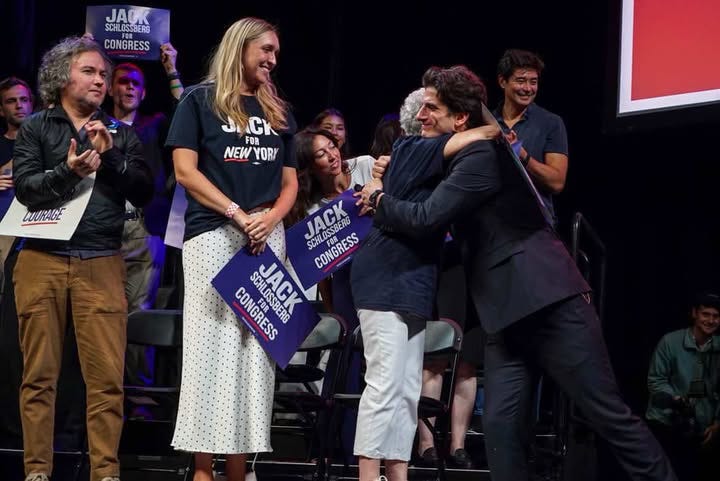
I see it differently, which is why I’ve served as a volunteer canvasser for Jack Schlossberg’s campaign, despite living in Brad Lander’s district, who I also support and for whom I have also volunteered. Contra the reportage out there premised on a few disgruntled sources, the energy I have encountered on the Schlossberg campaign is good. The values he stands for are meaningful, and frankly, courageous, given the district where he’s running. He’s walking the walk in a way none of the other leading candidates in NY-12 has. (Nina Schwalbe, whose platform is excellent, is running far off the lead.)
Is Schlossberg young? Yes. Is there room for him to grow? Also, yes. Still, I’d hope if we have learned anything by now it’s that more elected technocratic functionaries with billionaire donors are not going to broaden the appeal of the Democratic Party, or push us collectively beyond the long tail of Ronald Reagan’s presidency toward meaningful, and lasting, progressive reform.
I recently had the chance to put a few questions by telephone to Schlossberg.
JTP: Your maternal grandfather would have been 76 in 1993, the year that you were born. You never had the opportunity to know him in life. What are some ways, large or small, that he has been returned to you over the course of your life, and are there ways this campaign has made you feel closer to what he lived?
JS: Thanks for that question. I know that I’m lucky because most people don’t have a whole public record and a presidential library of their grandparents if they didn’t get to know them. And I have so much. I know him through his speeches, through the things that he wrote, and the stories people tell me about him. All the time. And on this campaign, I’ve been feeling respect for how he was 29 when he ran for Congress. And he was, what, 43 when he got elected president? It’s just incredible that a young person was able to do all that, and touch so many lives, and still be so relevant all these years later. I’ve been reflecting on how that’s even possible. And how the words, and the policies, of the Kennedy administration, are really evergreen — and something both Democrats and Republicans try to claim ownership of now.
JTP: The New Yorker’s Editor-in-Chief David Remnick began an interview with you by offering his condolences for your sister Tatiana’s recent passing (which of course I reiterate) before questioning you with the same patronizing tack others have taken in regard to work experience. This, in implicit contrast to Alex Bores’ work at Palantir as company point person to the first Trump administration, and four years in Albany advancing legislation including AI regulation. Let’s get into that history. On the campaign trail, Bores has specifically cited the threat... to his career... posed by the superPAC spending against him as a reason to vote for him. As if Alex Bores’ career—and not the ends he wants to achieve through public service—were the primary concern for voters. There’s almost a suggestion that if he does not win this race, he will go home and take any possibility of AI regulation with him. Is Alex Bores the only person in the country who can hope to regulate AI, or would you also advance such regulation if elected?
JS: Of course we need to regulate AI, and I’ve been saying that throughout the entire campaign. The most important thing voters should be asking is whether the regulators themselves are disinterested parties. Meaning whether they have a dog in the fight of the AI battle between giant companies, which are, most of them, about to go public. It’s a mistake to act like Alex Bores is this leading crusader on AI regulation. That’s a great story that he tells. But when you actually look at the proposals he’s offering, they’re a dream come true for the big AI companies. And he’s relying on voters not understanding the difference. He touts his plan for an AI dividend, right? That’s exactly what AI companies want. They want a fixed cost that they can just pass along to consumers. And to have the tax code on their company be based on usage, which punishes smaller start-ups as opposed to these huge well-capitalized companies. He talks about the RAISE Act as this big win, but it has nothing about jobs, nothing about kids, nothing about the environment... It’s fairly meaningless AI-legislation, and the reason he’s gotten the attention, and the attacks from superPACs, is not because he’s in favor of AI regulation — it’s because he’s bought and paid for by that superPAC funded by OpenAI’s competitor, Anthropic. Which has come out with regulations that it would support. The idea that these companies don’t want any regulation at all, which is what Alex Bores has been saying, is just not true. I reject this idea that one AI company’s money is good, and the other is bad. We should be skeptical of all of that money coming into this race. And as it pertains to the pursuit of AI regulation, Bores is taking not just some money, but millions on millions of dollars from the biggest AI company and not being up-front about it. It’s outrageous.
JTP: The allegations of astroturfing by Bores’ people that have been simmering for weeks, then investigated by Instagram account @kaitlyndoespolitics, apparently were confirmed with reporting by Politico’s Jason Beeferman. What is your view on these tactics, and voters’ potential unknowing endorsement of said tactics by voting for Bores, and of dark money in politics, in general?
JS: I think we’ve been talking about manipulation of social media since 2017 with Trump. When this stuff started happening, I knew that it was non-organic. Whoever did that was clearly using the Israel issue, and anti-Semitism in general, as a political weapon, at the same time they’re trying to court Jewish voters here in New York-12. It points to the fact that we really need laws on the books about paid-for social media content. We need to regulate these algorithms. And we can’t have insiders from the tech industry be trusted to regulate them. It’s just so insidious, because when you see an ad on TV, you know it’s an ad. But when you see this kind of content online, it can present as grassroots support.
JTP: Let’s shift to Micah Lasher, the consensus insider favorite to win this seat before there was any polling in the race. As of the most recent debates, he is appearing quite confident. Unlike Micah Lasher, you have been out ahead on refusing superPAC money, on a pledge to withhold offensive weapons from Israel’s military, and you also endorsed Mayor Mamdani’s candidacy even before it looked like Mamdani would win. All of those stances are, to my view, courageous. You are also the only candidate proposing to let renters deduct rent from their taxes. You’ve already staked out the importance of pursuing another impeachment of Donald Trump, which Lasher first pooh-poohed, then lied about having pooh-poohed as he later tried to claim your position as his own. With respect to differences between Micah Lasher and yourself, how do you envision the role of a member of today’s House of Representatives?
JS: It’s really telling that Micah Lasher bills himself as a progressive warrior, and a Democratic Party champion, while, as you’ve pointed out, being on the wrong side of many of the defining issues in this race, and being bankrolled by a single billionaire. I just don’t see that as the way to go. We really are at a crisis moment in this country’s history, and for the Democratic party as well. We’re fracturing right now, and we still don’t have an answer for what to do about Trump. And the only answer that has ever worked throughout American history, to make progress in this country, is to engage a new generation in politics, and to actually have political leaders with courage who are willing to fight for their values. I think the value of this district, in particular, is one where you have to have somebody who’s going to lead with courage and integrity. Because this is a safe blue seat. And whoever’s going to be elected has the opportunity to be a leader for the party and the country. If we haven’t figured out already that candidates who lack grassroots support, and who rely on ultra-wealthy mega-donors for their election, is not a recipe for success for the party, then... Whoever is elected for New York-12 should not only be able to represent the district here, and advocate for the people who live here, but they should also add something to the party nationally. I do not think that Micah Lasher does that. I think that he fades into the background in Washington. By contrast, I would be able to get things done in Congress while — I hope — also being a huge asset to the party by being colorful in the way that I am, and I think that’s exactly what the people in this district need from their representative.