

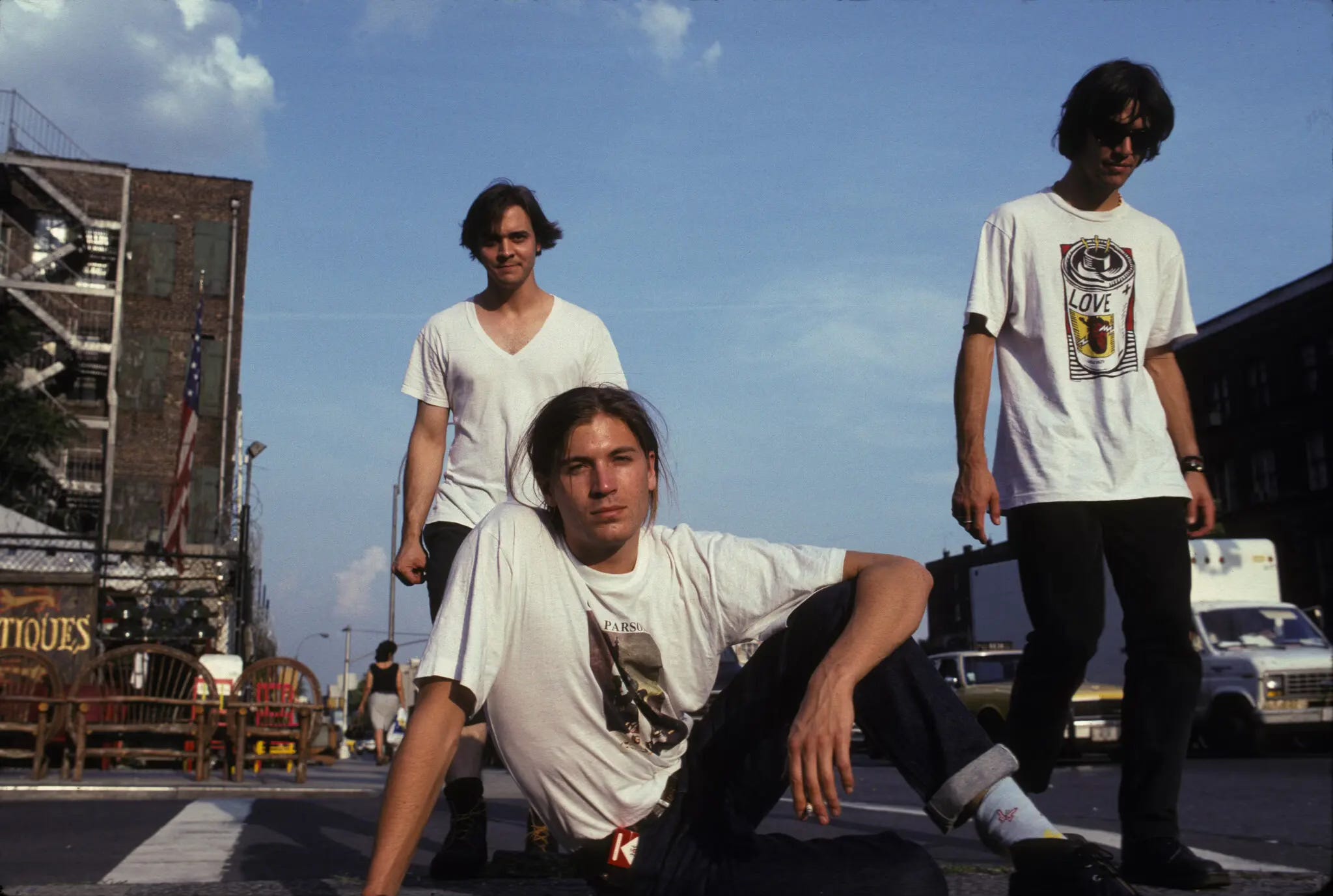
note: all lyrics quoted below were either written or covered by the Lemonheads
note 2: The Lemonheads are playing a free show tonight, 1.22, at Lucinda’s in the East Village, doors 6:30 pm.
note 3: David Ryan will appear at Newtonville Books in conversation with Rick Moody for the continuing launch of Alligator on 2.22.
Evan Dando says that he’s no longer famous.
Or not, ‘says’—writes.
But not writes either: his memoir, Rumors of My Demise, is an ‘as told to’ author Jim Ruland, who assembled the text based on correspondence with the singer and frontman of veteran musical act the Lemonheads. The book published in October of 2025 with a New York City launch in the Rare Books Room of the Strand where Dando, after a fashionable delay, sat to answer questions from Professor of Classics at Rutgers University-New Brunswick T. Corey Brennan. In another lifetime, Brennan played guitar for one of the earlier incarnations of Dando’s band.
The professor’s approach to channeling conversation with Dando was a show ’n’ tell method: he’d go to a tote bag and break out what might as well have been ancient Roman artifacts: concert posters, magazine covers, record sleeves, and the like. Most all were from the ’80s and early ’90s, an era when everything felt lacquered, deceptively shiny, and like all the important events had already happened; all we had to do was prevail over “the Evil Empire.” And then we did? The Lemonheads, for their part, set out to be the opposite of shiny, but time has done its trick and made what might once have looked like trash precious.
Dando gave a good impersonation of exact recall for each prompt. Shown a magazine cover with his likeness on it he said that at a certain point in his “alternahunk” era (he found the label ridiculous but went along with it) people tended not to take him seriously and to treat him like a hunk of beef. The vibe in the room was warm: I got the impression that in attendance were not only old friends but possibly family members too. What he was recalling, as if it had happened only a few minutes earlier, were the band’s early days in and around Cambridge: their relationship with a local college radio station; the Lemonheads’ sold out first show; not being very good, but versatile and well-liked enough as would-be punk rockers before the band—or well, Dando and a rotating cast—transitioned into something pop rockier, more country, more melodic. (One description that Dando says in his memoir he could do without is ‘bubblegum grunge.’)
When he alluded to the Lemonheads’ first major label album Lovey, which didn’t sell well at the time of its release (and never on par with the band’s two hits, It’s a Shame About Ray and Come On Feel the Lemonheads) an audience member called out with tremulous earnestness that it was the band’s very best. Dando acknowledged the remark with a nod; at the least no one could deny that for that audience member this was the indisputable truth.
On making his entrance Dando had appeared in a sport coat over a rumpled button-down with his weathered acoustic guitar in tow, skate shop sticker slapped on the front, and it was at the juncture in the interview when Brennan sought to discuss the Lemonheads’ transition from indie outfit to major label band—Atlantic signed them on the early side of the Nirvana-sparked grunge wave—that Dando abruptly stood from his chair and started to play songs in front of the rare books from a hundred years ago or more lining the wall behind him.
His tall frame shambled one way, then back the other, head tilted downward as he sang, in strange dialogue with the title of his memoir, “Life is short and unforgiving/ I only fear the living.”
The songs after that tended towards the more upbeat. He took at least one request. He playfully chastised a mother whom he seemed to know in the first row after she interrupted his performance with commentary of some kind: “Who is playing a song for who?” The audience laughed.
People wanted to engage. They were not cowed. His mere presence felt meaningful, the love in the room reflecting back at him. Nobody seemed to want his help in redefining the universe or discovering a new framework of understanding, a new language. There was nothing ponderous about him save the prospect of his age, which has definitely started to show. His lifelong defiance of the expectations placed on him by others has taken the form of, well, yeah—forgive the pun—a sort of grizzled evanescence. Even on the occasion of the publication of his memoir about his remaining among the living despite unfavorable odds placed on him by heavy drug use and a life more scattered to the wind than really anybody can imagine, one that he might be hard-pressed to remember in exacting detail himself. Living’s meant to be felt, after all, and not bottled up in Bell jars for safekeeping. The still expanding catalog of Lemonheads songs all carry that feeling, even when the feeling is broken, or bottoming out, or deadpan villainous. ‘Evan,’ his legion of better angels might want to sing back at him, ‘Stop playing that dark role! Remember yourself.’
Living out the role of walking contradiction for so long tends to take a toll, apparently.
During the audience Q&A, with reference to Brennan and the others who have gone on to distinguished careers in music, film, academia, advertising, law, and letters, somebody asked, “How do you account for how many former Lemonheads have gone on to do amazing things after leaving the band?”
Dando didn’t really hesitate, even as he smiled. I didn’t write down his answer, and don’t have video—maybe someday, the Strand will release it from the vault—but my paraphrase goes something like, ‘Well, we were in and around Cambridge, and so the answer is easy: it’s social class and schooling and motivated people.’
The first time I heard the Lemonheads was as a thirteen year old spending the night at a friend’s house. Maybe in a sleeping bag on the floor? Or in a twin bed side-by-side? Dark room, approaching midnight, with ambient light from the lamps outside on a quiet suburban street. We were talking, my friend and I, as I tended to do whenever I spent the night anywhere. Voices in darkness. An older, cooler cousin of his had turned him on to new music. There was something just so immediately relatable about the voice in the songs on the cassette he played. I’d grown up in a bubble of oldies, the music favored by my parents, which I felt viscerally to be all that was worthwhile, but right away, the sound of It’s a Shame About Ray got me. Dando’s voice reached the words, “As the cars fly up King Street/ it’s enough to startle us/ It’s enough to startle us,” and a car did, in fact, go by outside, headlights throwing blue shadows in a search party across the ceiling, and although I didn’t have the language then, the feeling, I guess, was, Whoa, synchronicity.
I was fairly tightly wound as a kid—driven to excel academically, to impress teachers at the private school I attended—and there I was on what felt like the cusp of adulthood, in the pivotal year between elementary and middle/high school, and here, word from an advance scout in the adult world had come back to me with the apparent news that it was acceptable to be a big kid out there beyond the horizon? He sang about drugs more than I would have liked, but the songs sounded so alternately exuberant and chill that the effect couldn’t not be infectious.
The release a few years later of Come On Feel the Lemonheads corresponded with my first stereo, which was placed in a small, almost perfectly dimensioned wooden cupboard with the door removed next to my bed. The album felt more erratic to me, less tonally consistent, kind of jagged, and some of the songs straight up confused me then, even while others, like “Into Your Arms,” “It’s About Time,” and “Being Around” felt like dispatches from the continuing adventures of Big Lost Kid Dando. As locked up inside myself as I was starting to feel as an adolescent, Dando’s yearning presence in the songs struck me with awe: all of what I was learning to hide away, he was outright leading with. It felt, I guess I already knew, dangerous somehow, to be a guy who sounded as emotionally available as he did. Even if, sure, it may not have been clear whom exactly the singer loved—given that so many of the songs are about relationships dropped on the turn of a dime. In a way, maybe it was always apparent that, years before Christina Aguilera released “Beautiful” (which Dando would go on to sing himself in much later cover album Varshons II), one of the primary subjects he was singing his love for was himself marveling at the freedom to make himself the primary subject of his songs: youthful ebullient narcissism given epic flight by a then-booming record industry. But maybe that’s too clinical, and doesn’t accurately capture the phenomenon of the Lemonheads at the height of their global fame? What was cool about him, what subversive: the ride Dando was on was that of everybody who saw themselves in him, or conversely, those, in a gender reversal, who experienced his persona as Squire-in-Distress in need of rescue by some brave, conscientious maiden.
Things eventually got pretty dire—for me, I mean, by senior year of high school, I’d gone from being a popular kid at the outset to almost totally alienated at the end and obsessed with popularity as some kind of inescapable but still bullshit metric. If only, you know, we could just get each other, just go outside the bounds prescribed by our suffocating cliques, and just be individuals open to the lived reality of one another; if only empathy were king, or queen rather, and we could just do away with all the pretense and tear down the walls and see each other instead of obsessing over celebrities and our desire to be like celebrities, with everything seemingly a quotation of a quotation, and nothing in our own lives worthwhile with our lingo and terminology and shorthand appropriated from the lives of others, of what we perceived as “popular” and “cool.” My final spring in St. Louis, I have this distinct memory of the girl I was crushing on entering the senior lounge at the end of a school day and lying down on the couch opposite the one I was lying down on, such that the two of us were the only two people there, on opposite sides of a fairly tight, windowed room looking out on the quad. She wasn’t someone without tragedy in her life, beautiful in part because of how she projected sweetness and good cheer despite that fact, and she’d wear this iridescent blue shirt that complemented her translucent blue eyes, and was both cheerful and sad, and it wrenched at me, I wanted so badly to speak to her but felt dislocated, so not-what-I-ought-to-be, sick and not wanting to talk about being sick, slated for surgery the summer following our graduation at which time this awkward holding period in my life would surely end. And there she was, right across from me (on her senior page, revealed not long afterward, she would share a quotation popularly attributed to Goethe, “What you can do, or dream you can, begin it. Boldness has genius, power, and magic in it”), and my feelings went out to her, and it hurt because as much as I was drained from what was medically awry with my body, I was also conscious of what serendipity it was that she and I would end up at the end of a day opposite one another, and how fitting, a fateful moment of connection, but ironic, too, because I couldn’t bring myself to speak the first word to her. But maybe not speaking was exactly the correct thing. Maybe we were just two people marooned in our respective sadnesses and better to let that be. And yet as much as I might have appeared completely contained by a lack of outward speech, I at the same time felt myself to be completely with her. Like an impacted tooth, my personality felt buried beneath a surface whose threshold I couldn’t manage to cross. Rather than therapy, I gave my attentions at home to the Lemonheads’ Car Button Cloth: “If I could talk, I’d tell you/ When I can smile, I’ll let you know/ You are far and away/ my most imaginary friend”; “There’s a disease going around the hos-pit-al/ Green, green leaves/ Falling from the trees”; “What a comfort to find out you’re losing your mind/ When you re-realize it’s not the first time”; “This is the place/ where I save face/ This is the spot/ where I jump off/ I’m over the pain/ and I’m past the bleeding/ It’s not the tracks/ It’s where they’re leading.” I wasn’t in the habit then of memorizing poetry—who would I have recited it for?—but without trying I committed those lyrics to heart so deeply that I have them at the ready today, almost thirty years later. Dando’s words arrived as a way out from the dead end of my alienation, while at the same time, it felt readily apparent that Dando himself had hit some pretty dire straits.
So much so that a year later, in college, I made a deliberate choice to stop listening to Car Button Cloth for all the mirroring in darkness it had once offered. The circling emotions I’d felt toward the tail end of high school became bottled up with that album, archived in some recess of my mind. Many of those lyrics read as so discursive, with meaning so willfully cryptic after the lambency of It’s a Shame…, that just about any listener would have to wonder whether Dando’d ever find a way to surface again. (At the same time, the album is interlaced with a song as warmly humorous as “The Outdoor Type”—albeit one that Dando performs brilliantly but did not write himself—and as bleakly deranged as “Knoxville Girl” and “6lk” aka one fan’s response to David Fincher’s harrowing Se7en.) Still, though, It’s a Shame… never left the rotation, and soon enough I was reclining on a futon with a redhead from Nebraska smoking a joint and talking about our mutual love for the Lemonheads. The drug buddy I’d projected into the future on long-ago sleepovers had become real, sitting and laughing alongside me. If I’d ever felt “too much with myself,” maybe it really was possible to “be someone else”? I took my first fiction workshop sophomore year of college. ‘Writer’ had been my notional identity since senior year of high school.
Two decades later I was standing on the porch of Merrill House during the summertime Colgate Writers Conference when my attention turned to the wild-eyed author who had appeared before us as a guest reader earlier that night. He was speaking with another author who also led a double life as a musician about having been a part of some band, and I thought someone had just said that the band was the Lemonheads? A young woman interlocutor who’d never heard of them and was only repeating the name because she thought it sounded funny. I couldn’t believe it. My surprise and genuine awe must have shown. This was David Ryan, the Lemonheads drummer for albums Lovey, It’s a Shame…, and Come On Feel.... We had a beer that night with the rest of the motley crew at a bar in Hamilton and rattled back and forth about Denis Johnson and near-death experiences and I really had to try hard not to ask, And what about…? And what about…? with respect to everything I hungered to know from my side of Lemonheads fandom, an obsession long buried. I was old enough then to think I knew it was a good thing not to look too impressed by anybody. Dando, meanwhile, had returned to performing under the banner of the Lemonheads after a hiatus that ran through 9/11 and his getting married, before releasing a new album with new performers in accompaniment. But that album hadn’t commanded much attention, and I only encountered it years after its release: a few good songs on which Dando sounds genuinely better-adjusted than he had in years prior (“Let’s just laugh”), plus the same humor so dark it almost defies calling it humor (a tongue-in-cheek crooner about murdering a cheating lover) but overall, J Mascis’ guitar parts notwithstanding, there’s a kind of flatness of affect. Dando sounded as if he’d become, through friends’ and lovers’ care, maybe a degree more cognizant of his good luck, but also as if the long-standing heroin jags had taken something from him.
Eventually, David Ryan published a story of mine (in truth, an excerpt from a novel manuscript I’ve never completed) in Post Road Magazine, which he edits to this day. I attended the Greenlight Books launch of Ryan’s pretty amazing little book of memoir/celebration of Malcolm Lowry’s Under the Volcano, a midcentury novel about being under the influence. Ryan relates Lowry’s magnum opus to his own experiences on tour at the peak of the Lemonheads’ global fame. I took a train up to Connecticut near the ocean for lunch where Ryan lives, and he spoke about the crazy old days, starting out working in a late-night donut shop in Cambridge, then toting around the brick of Joyce’s Ulysses on tour, the transfiguration of his post-fame life, living close to uptight neighbors, and the experience of bringing his daughter to a nearby town where she chanced to encounter both a poster announcing an upcoming author reading of his and at a record shop, another poster featuring the cover image for Come On Feel the Lemonheads across which a fractal of Ryan’s youthful face appears. Seeing those through her eyes made him really feel like somebody, he said. At that point, Ryan hadn’t spoken with Dando in years. I’d asked enough about it, with whatever degree of restraint, to pick up on some underlying tension. It gets to be interesting in thinking about influence and the kind of wake a performer leaves through all the madcap wheel-spinning, the self-destructive swoons.
“I’ll never forget hearing the songs played back to us when we were done,” says Dando of his first recordings with original bandmates Jesse Peretz and Ben Diely. A watershed for a wild, rebellious teen from an affluent family grappling with his parents’ divorce, his father’s absence.
I don’t know exactly what I imagined Dando’s upbringing was when I first heard his voice, but I’d never have guessed that he was a private school kid too: Commonwealth in Boston, where he met Peretz and Diely. I’d never have guessed either, although I suppose the truth must have always been out there, or even a matter of public knowledge, that Dando’s two original bandmates matriculated at Harvard while he went off to give Skidmore a try, before swiftly dropping out and moving back to the spacious family apartment in central Boston, then into a narrow closet space in Diely’s pad, which he lined with photographs of Charlie Manson, and every night communed with those photos before flicking out the light, or hosting a girl through whose mind god only knows what thoughts must have run. Dando possessed just enough abiding sweetness to pull that off without seeming a total creep, or maybe it was a measure of self-protection, intentionally seeking out the edgy and frightening—the monster under the bed, as it were—in order to internalize and overcome it. Or perhaps he wanted on some level to get at the heart of a cultic mindset on which a band’s success depends? But what it never could have been was so conscious-minded as the attempt to make sense of behaviors after the fact. As the dropout in the group, he had as a sure prospect only the hope for the band’s success, or at least it’s becoming something real enough to sustain him. I’d never have guessed any of that, but I suppose the signs were always peeking through, had I dug in deep on the Lemonheads’ early records, which sound like two or maybe three different bands trying to be one.
In Rumors of My Demise, Dando details his obsession with Manson, how that influenced his lyrical stylings, which you can hear as recently as the first track (“58 Second Song”) on newly released Love Chant: “Never forever is a long time to live without / Never I don’t suppose / I wouldn’t think it anyway/ …Nobody knows the truth from the truth.” The evasive wordplay, the negations on negations that convey a twisty sense of meaning, one a listener could feel is somehow always a little bit out of reach.
The band’s earliest lyrics tended more towards directness, as in Diely-authored “Buried Alive”: “Said the wrong word at the wrong time/ Buried alive!” They made allusions to Emily Dickinson and screamed out their fears of social opprobrium. Harvard punk rockers—it’s an inherently funny concept on its face, and maybe good reason for the band not to have advertised that. But then again they weren’t just Harvard punk rockers, because they had Dando, and the story of the Lemonheads taking shape, or never really taking shape but continuing to evolve in candor and self-contradiction, is one of the inherent tensions there, of Famous Rock Star Dando born from the fluctuating inner dynamics between three friends who, at first, strove to be entirely egalitarian in their punk confrontations from the stage. They went so far as to trade off instruments between songs. Depending on whose number it was, that individual would take up the frontman position while someone else went to the bass and drums.
Jesse Peretz came from a family so monied as to have a Rembrandt painting occasionally passing through their apartment, “which,” reports Dando, leaning hard again on candor, “is so over the top that Jesse asked me not to write about it in this book.” For his part, “Jesse thought going punk in 1985 was the lamest thing you could possibly do, so he was all for it.” “Going punk”: that’s the vantage from a jumping off point of privilege where someone “goes” something rather than inherently being that thing—of entertaining possibilities, awash in pleasure and alternate, contradictory selves, and electing to become something rather than having that something forced by difficult circumstances. Dando ran with it, like a goofy, elastic cartoon, but the broken endings did start to accrue, the tendency to avoid rather than confront, and get on top of, what was troubling from ‘inside the house’ of his mind.
Insofar as it might read as funny—or for those of a certain vantage-point scorn-worthy—that Harvard guys from wealthy families wanted to be punk-rockers, it helps to remember that this was around the same time when rockers of middle-class origin Paul McCartney, David Bowie, Keith Richards, and in the longer run, Bob Dylan, Neil Young, and Bruce Springsteen were all on their way to becoming ultra-wealthy. The challenges to Dando that he wasn’t from the right background to become a rock star had started coming directly from his older sister practically as soon as he began as a kid to sing along to the radio: “Evan, I’ll tell you one thing for sure: you’ll never write a song and you’ll never be in a band… because you’re not the kind of person who can do those things.” As long as we don’t live in a society where only the well-to-do can become remunerated artists, it’s a liberating thing that he did.
Before the Lemonheads were the Lemonheads, they were “the Whelps,” and then, because Dando and Peretz hated that name, they started to shop around for a new one while Diehl, whom Dando credits as the driving force behind their group in the earliest days, was away on vacation. Among those possibilities discarded as unsuitable along the way: Yipes Stripes!, Ill Willy and the Tendershoots, and The Piggy Popcorn Queers (another sorta Manson echo). Who knows if these were ever truly in play, or if Dando was just having fun with Ruland, but the goofy names are still a laugh. Finally, though, they landed on the one, and “when Ben came back from Brazil, he was so pissed off that we’d tossed the name the Whelps and adopted Lemonheads without any input from him [that] he threatened to quit… Ben’s family supposedly had something to do with the Tootsie Roll empire, which maybe explains why he didn’t like our candy-themed name.” “Sour on the outside, sweet on the inside” is a line that Dando has used in interviews over the years. Another possible meaning emerges over the course of the memoir: a fear that something was inherently wrong with his brain, the “lemon,” in the used car sense, on a lot of pedigreed futures.
Dando had to renunciate his place in the band before he effectively became the band, or “the collective,” as he half-jokingly calls it, in which he remains the sole constant. After a few albums, tensions between him and Diehl had reached the point where Dando left for the Blake Babies, Juliana Hatfield’s early art band, which he refers to in Rumors… as akin to graduate school. But then the Lemonheads’ previously recorded cover of Suzanne Vega’s “Luka” became a hit, and the guys coaxed Dando back, only for Diehl, whom Dando says resented the idea of signing with a major label, to leave the band to pursue studies in Irish literature (specifically, a conference on William Butler Yeats). Or rather, the band had the opportunity of a European tour that summer, and it conflicted with the Yeats, and so, as Dando writes, “[Ben] followed his heart.”
With a rotating cast of band-mates over the years the Lemonheads are something like a real-life version of the Spinal Tap joke about a trio whose drummer keeps disappearing (calamitously dying, in the mockumentary, which fortunately no drummer of the Lemonheads ever has). But at the height of their touring days, as portrayed by Ryan, things were pretty far off-the-wall. Dando’s memoir, which provides a lot in the direction of comprehensibility for someone whose life has largely been about defying expectation—when interviewed by the New York Times about the published book, Dando told the reporter that so far he’d only read, and offered edits on, the first four chapters—brings the reader along for memories of how Dando feels world catastrophe seems to shadow him (the LA riots, 9/11); of Winona Ryder having turned young Johnny Depp onto It’s a Shame About Ray before Depp approached Dando cold at a Hollywood diner and introduced himself such that the two became close enough to hold endless conversations paired horizontally across Depp’s bed after Depp’s relationship with Ryder had ended; of finding refuge and creative ferment in Australia before eventually getting so lost there that he was tripping out of his mind and crawling on a sidewalk, crying and placing coins between the cracks, until managing to get his sister in New York City on the phone so that she could talk her brother who-was-never-going-to-be-a-rock-star back from the other side of the planet; of rehab; of missing a show-time in Glastonbury because he was holed up in a faraway hotel bed with two famous closeted lesbians and a bag of heroin; of more rehab; of playing the part of amicable rock star at the bar, on so, so many nights in New York City, picking up the tab for friends, old and new and never-seen-again, and eventually nesting in a Soho all-hours scene revolving around smoking crack with up-and-coming models; of dealings with reporters toward whom he was initially honest to a fault, then more inclined to tell tall tales; of a lasting friendship with Marlon Richards, the guitarist Keith’s son, and entering onto the Connecticut orbit of the Rolling Stones legend; of having his first wife walk out on him; of taking refuge in Martha’s Vineyard where his father had long maintained a house that was a summer refuge and locus of pleasurable abandon in his youth until Martha’s Vineyard, too, got colored perhaps too much by the damage of addiction (heroin, lost teeth); and eventually, in culmination, marriage to Antônia Teixeira, the daughter of a famous Brazilian singer-songwriter and the center of the circle of love from which he is telling his story.
In the deepest throes of addiction, the jadedness engendered there, Dando must have doubted whether a full memoir could ever take root. Or maybe that’s a little too neat of me to imagine: a skilled ghostwriter can work miracles, no doubt. Maybe as a student of American letters, I’m a little too inclined to find some happy resonance with Willa Cather’s My Antonia (definitely a sad and not a happy novel about lost youthful possibility and seeing beyond the foreordained borders of our lives) whereby Dando, who, for whatever his many colorful faults might be, has never hesitated to champion women, or to point out double-standards in how the media treated female contemporaries, or to put his own identity on the line as a kind of shield against antigay prejudice, would, in the end—if it’s an ending (just writing that because I can almost feel the rebel impulse to overturn it all)—find solace with a woman named Antônia, while it is Dando who lives as the shadow of the pretty boy he once was, and, like Antonia at the end of Cather’s novel (spoiler alert), is missing a few teeth out of the passage of time.
I wonder about influence. Wonder about wakes. How the beacon of someone’s presence in the arts affects the generation that follows, and on what level, and how widely, and how deeply. Does influence happen mainly through breadth and duration of popularity? Through longevity regardless of how popular? Through the brilliance of specific works that cut across time as if not a single day has ever passed?
David Ryan’s brand new story collection Alligator begins with the title story, a metafictional reflection on the precarity of our lives, the foundations we build that, in dreams, may crack asunder, and the relationships we hold that, given a few different turns, might have been lost. Ryan writes short fiction with the drive of an avid practitioner; no piece feels final; it’s about the succession, the reverberations, the furious ongoing experiment—like the globe-hopping drummer he once was, doing his thing before all those watching eyes and ears and bodies, varying up the tempo to stay fresh, a performed fervor as underlying proof of life. A heartbeat. In “Alligator,” the story, the central symbol of an alligator takes on layers, slowly altering in valence from cute ’n’ cuddly on a child’s t-shirt to something more ominous and with an appetite all its own. The effect is as of a dreamer attempting to wake up from a disorienting nightmare in which the warmth and steady comfort might have been the dream, and the nightmare, reality:
This is the story of the alligator. About when I woke thinking the boy was awake and crying in the next room… and that this boy, my son, no longer trusted me—but there isn’t a little boy, there aren’t any kids, there isn’t a next room or a co-sleeper or crib or bed. There isn’t the blanket-tangled body of my wife in the bed beside me when I reached out and grazed her missing arm, her nightshirt not gathered up, her warm skin nothing but the cold flat sheet, my faith like a hallucination dispelled, replaced with the snap, like a shape, of terror in the stone indifference of the bed. I had been waking in the middle of the night with this kind of terror. Of your absence from my life…
In Rumors… Dando makes a remark to the effect that [my paraphrase] ‘modern rock stars have basked in the warm attentions of the immediate college and post-college circuit,’ the institutional cauldron where kids go to explore their identities and embark on sexual relationships of whatever variety en route to an adult understanding of the world and their tenuous place in it. In a way, the role of famous rock star has always been the perpetuation of that state of being beyond a standard allotment in a kind of never-ending adolescence. When rock ’n roll broke out in the 1950s and early ’60s across a widely repressed America, no allotment was standard: kids met, dated, got married, because it was expected of them, not because it was what they felt they wanted at heart. Whereas for Ryan, in his fiction, the horror would be the loss of those intimates who anchor us in ourselves, for Dando for so, so long, his work has been largely about the escape from those intimates who constrict us, the feedback loops that bring us down, and against whom we rebel to become who we feel we need to be. And yet at the far end of that tendency is the fear, perhaps, that no home will ever really be home again, that nobody can ever know us as once we were known, and what we are fit for is dissolution and an early grave.
Dando has always had an inclination toward a diverse array of cover songs, of acting out identities borrowed from others, which might also read as an expression of the privilege of his origins. “Amazing Grace,” “Luka,” “Frank Mills,” “Mrs. Robinson,” “Into Your Arms,” “The Outdoor Type,” “Speed of the Sound of Loneliness,” the full albums Varshons and Varshons II, to name only a few from that continuing proliferation. Nowadays, Lemonheads performances tend to close with Dando alone before the audience with his guitar, just as he was in the Rare Books Room at the Strand, and cycling through cover songs on a free-associative, seemingly spur-of-the-moment frequency, embodying his hard-earned freedom from the “sparkling lie”: his voice may be, now and again, pretty damn frayed, but the tone bends toward sweetness and off-the-cuff candor, no matter that the song he sings might well be a dark one. Behind that darkness there remains Dando peeking out, as if to say, ‘Hey, I’m just playing!’ There is, too, an inherent generosity to that instinct, of giving voice (and alternahunk?) to the work of others, like an actor proving his chops by reciting Shakespeare.
“It’s about time”: At long last, after decades performing as more or less a monument to the teenage heart that set out in pursuit of punk rock (how many tribute tours for It’s a Shame… and Come On Feel… can a guy be expected to do until it gets to be like fully realized ouroboros, a performer in a permanent cover act of his own younger self?), Dando has surfaced again.
Insofar as a forthright memoir is a demystification, an accounting for the origin of every song which has provided emotional scaffolding for fans over several decades—we learn, for example, that King Street from “Drug Buddy” was in Australia, and that Dando, no matter how chill he sounds in the song, was strung out on meth in writing the lyrics, but detoxed when he recorded it and with the great and good artistic sense to recognize that maybe it would be cool to dial the clamor of the sound down, do the opposite of the thing that was cresting a wave of popularity then—a new album is an opportunity to invite new associations, even if, for “no longer famous” Dando, that’s from a diminished number of fans. Hell, maybe that even makes it cooler. The punkier-sounding Love Chant carries echoes of all that came before while being very much its own thing, a culmination of the long, lost years. Song “Roky,” a tribute to troubled rocker Roky Erikson, begins with a deep, ever so mildly countrified, electric guitar lick, “I don’t know any more than I did/ All those years before/ Can it get any worse than it was/ When the fever first took hold/ And it led me on to the world/ Where I don’t belong?/ But right now/ Well, I almost think I do.”
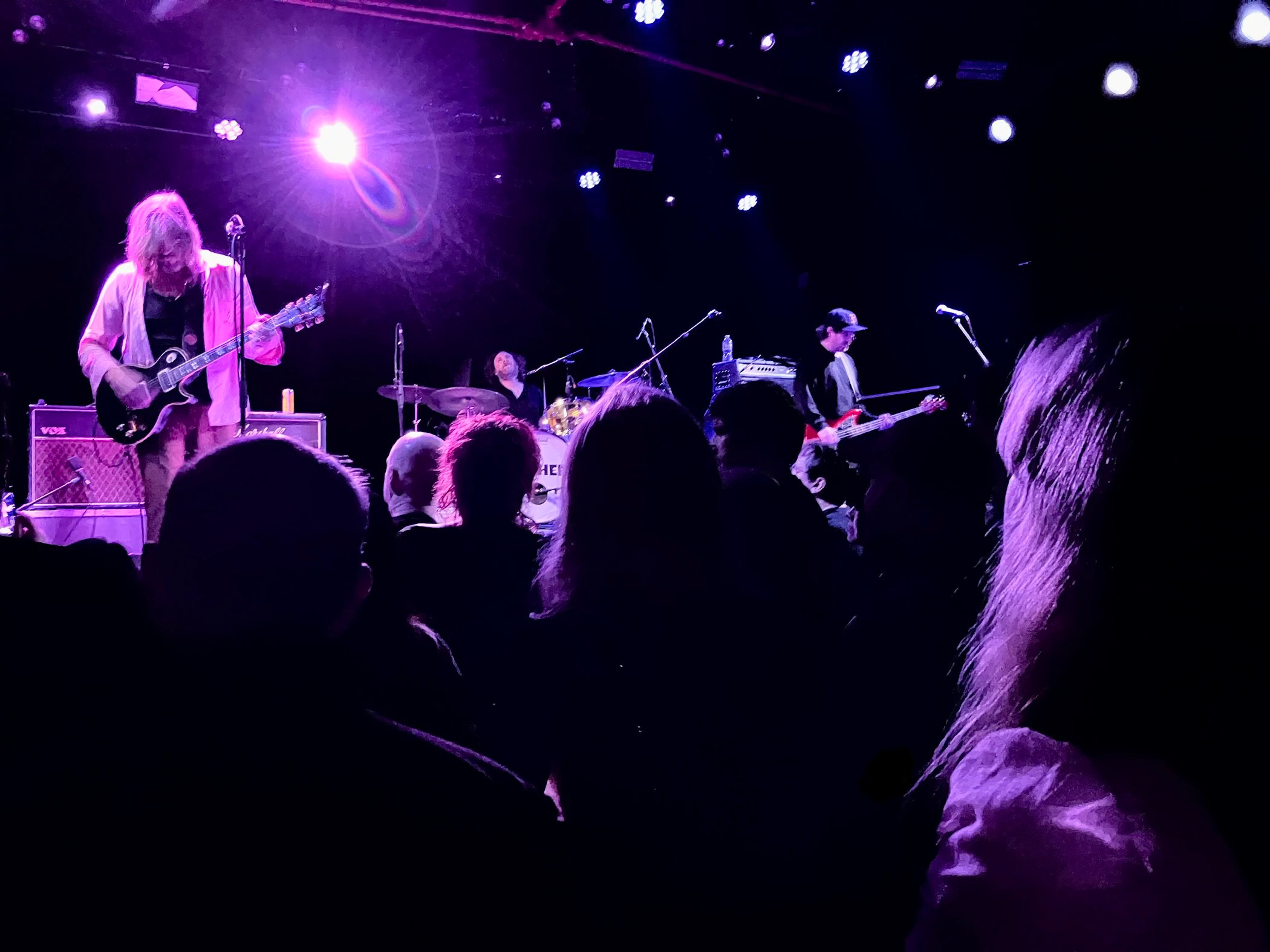
And he goes out there on stage at stop after stop, and sings it, in voice or out of voice, on tempo or a little bit off, soaking up the love or ready to split on a dime, with seeming recognition that the stage, no matter how inclined toward it any performer might feel, is somewhere nobody can ever exactly belong. Except, perhaps, in moments. From Love Chant’s “Togetherness Is All I’m After” (a song first composed by Blake Baby and sometime Lemonhead John Strohm): “The strategy of life/ Is that it’s gone before you know it/ And when you laid it on that line/ Baby don’t blow it.”
The Evan Dando of Love Chant isn’t any longer the globe-hopping rock star—even if he is, still, a globe-hopping rock star—but one among the number of “avid hobbyists” whose hobby is music, and whose plea is that he be transported from bad associations and whirlpools of negative feeling: “I needed a new world to be in/ That was you/ This world is you.”
And like some kind of living dialectic of a pun, he sings in “The Key of Victory”: “Livin’ anarchy, I’m livin’ in the key/ I’m livin’ in the key of victory.”
At the Strand, in approaching the table where Dando was signing books, I knew from Ryan that they had reconnected at some point over a video call during more recent years, maybe even around the time that Dando was recounting memories to Ruland. Dando had walked Ryan through the forest-fringed open air home where he lives in Brazil with Antônia, and Ryan, in turn, shared about the family life he has made for himself. And it was good. Both the call they shared after a long time not speaking—and the feelings for their respective lives. “Individuation” is what Ryan, once awash in mass spectacle himself, and now working on a more personal scale, calls it. (Books, really, no matter the prominence of the author, always function on a more personal scale.)
And so it came to be that I was waiting on line for the signing table behind which Dando hovered. Everyone there, of course, wanted a signature, or our modern equivalent, the dual selfie, or both, some token of intersection: See, here (“mark my path”) is where I stood before an idol.
Dando, in the conversation with Brennan, had referred to the memoir in typically self-deprecating fashion as like an album with a cool cover and a few good songs that doesn’t quite live up to the billing.
On the cover there he is, in black-and-white gravitas, no more the empty vessel, the passed-around beefcake, but fully bearded and meeting the gaze of his onlooker.
The final lines on the final page, a signature a la Joyce at the conclusion of Ulysses:
—Evan Griffith Dando
São Paulo, Brazil
May 2025
But lighter in spirit.
And funnier.
Although impossibly serious, too, because of what that sign-off portends: the day beyond which Evan Griffith Dando will exist only as a memory.
These private high schools, they encourage you at a young age to take the project of yourself seriously, to look around you and see the select peer group you are in, and to plot out a future worthy of your belonging. They make you feel watched over, as if a cloud of concerned and conscientious adults are looking over your development and hoping for the best. These institutions are, for all their flaws, vessels of pure potential for channeling pure potential.
Dando lived—lives—with his emotions out in front, which is, for our particular moment of hyper-repressed rage-filled young men getting their rocks off by lashing out at those with different colored skin, or at the women who won’t submit to them, all in pursuit of some deluded claim to white heredity, no small thing.
Concurrently, so often unspoken and unnamed except for political exploitation of that genuine hurt and rage, there’s the opioid crisis that has swept through America, hitting rural areas hardest. West Virginia, for example, where my father grew up. Vermont, for example, where I’ve had the good fortune to spend plenty of time over the years. The hopelessness addiction engenders. The sense of self circling a drain. The great glotted profits for a few tech oligarchs and a few drug lords, the harrowing chasms into which it’s possible to fall and fall and fall.
It cannot be crazy at this juncture in history to wish for a more egalitarian country, post-the long tail of Ronald Reagan’s presidency, but then it’s another thing entirely to leave behind abstracted political projects and theorizing to live directly as a focal point for the people. George Orwell, née Eric Blair, was the British equivalent of a private school kid, too, who wandered far off the rails in pursuit of some idiosyncratic critique of the class system that turned into, well, the stuff of legend.
The Orwellian-ness of Evan Dando is a sentence fragment I am fairly confident nobody has ever spoken before. After all there’s no great critique of class structure in the Lemonheads’ music, is there? Or, is there? More at the topsy-turviness of gender roles, more at the buoyancy of spirit, and challenges of staying above the surface, more at the empowerment of narrating your own story as opposed to having that story narrated for you, right? He’s been the young prince; he’s been the wayward bum: he’s lived the social mobility, up or down, that used to be the hallmark of the story the USA wanted to tell about itself. Dando isn’t serious—he can’t be! look! the drugs and broken rock star debris in his wake—yet is, too, as a Shakespearean jester, the player of songs.
I got closer and closer to the table, the line snaking forward, and couldn’t help but think of the weight of it all, our collective tide of expectation, on Dando, the demand that he iterate a signature over and over again.
Laugh to think of the Lemonheads putting out a final album from Dando in a retirement home, and somebody like myself plopping over on a walker to put earpods in and listen: eyes rheumy, hair thin to non-existent, sunspots on the skin like a stick figure Icarus painted on the wall of a cave. Hearing aid from having listened for too long, too loudly, to too many Lemonheads albums, turned all the way up.
It’s a joke—Dando, for one, I suspect, would put himself far out to sea before a day like that could ever come to pass—but says something about how the mass culture of youth all but inevitably diverges into individual stories. Nobody can keep being the persona that everyone else wants to see themselves in for very long without withdrawing from the public stage and allowing that created persona to take on a life of its own.
“Why can’t you look after yourself/ and not down on me?”: The band scene at my small Vermont college was mine my senior year, or at least the scene I shambled after: I drank more and smoked more bud than I had during any year prior, and periodically, in my adult life, as free, as shambolic, as it may feel sometimes, I’ve touched down again in that mode of being. For about fifteen years, my health has been mainly there, but it’s always a performance, the old wounds never quite healed. As for opiates, I’ve awakened in a surgical bed enough times [do not recommend] to know how intoxicating that can feel—freed at last from a body, the mind lifted up, like a balloon above it all—and the aftermath of skittering paranoia as pain returns en force, to recognize what withdrawal is too.
I’ve never approached Dando’s degree of addiction, not in the blaze through which he’s chased it. Then again, I get to experience the Lemonheads music in an addictive way that Dando never will. Because he is the one inside of the songs, his experience and sensibility the leading prow.
On the desk in front of him rested a stack of his book and in a jar, an assortment of markers of all colors: green, red, black, pink, silver, orange, onward. He’d pause briefly to take in each petitioner, then grab a color, and go to work writing that person’s name, with a short message (“Thanks!”), before signing his own.
For me, it was purple.
He leaned down, grinning goofily as I was probably grinning goofily back. A few of his teeth now, beyond those immediately front and center, are made of metal—silver—as if chosen on a dare.
I spoke the name ‘David Ryan,’ said he and I were friendly, and that I’d visited him in Connecticut where he lives with his family.
Without missing a beat, Dando said to say hello, and that they’d recently caught up, and sort of wolf-howled the name of Ryan’s wife, tilting back his head for a second as if to direct the name at the moon (which we could not see from inside the Rare Books Room at the Strand). But the way in which Dando did that was as if he were channeling the way Ryan himself speaks his wife’s name: I knew Ryan just well enough to recognize Dando slipping into an impersonation of his former band-mate.
“He has a new story collection coming out soon,” I said.
Now, Dando was busying himself with the signature on the open book in front of him, one more personal variation on the mold that convention was attempting to force on him.
He looked up at me, hunched forward, and spoke intensely, even as he slid the book across to me, “He has the prestige. He’s at the pinnacle.”
“Yeah, yeah,” I said, smiling.
Then took my copy of the celebrity memoir named for famous words attributed to Mark Twain and walked down the stairs and out into the night. With author signings, I hold to a superstition as with fortune cookies not to reveal the message until the cookie is consumed, or I am well clear of the table. On the subway I opened the book to the title page and what he’d written was my name, “JT” and his, “Evan,” side by side, with no further elaboration. Floating there in white space between title and author name. Like a question, for all the years of yearning promise, of what he or I would ever become.
Lyrics for 58 second song were originally penned by Marciana Jones, re: TSP The Sandwich Police. But maybe Lemonheads bought them? Is she credited on the song? I think there’s at least one other TSP song which Marciana would’ve been responsible for the original lyrics. I didn’t check album credits. But I see Marciana from time to time to time and she confirms this. Also I was around them when they were getting those songs ready to recorded the TSP releases, a decade or so ago.